How Much to Charge for Pressure Washing: A Pricing Guide
How much to charge for pressure washing: figure your hourly target, price by square foot or by job, set minimums, quote fast and raise prices.
The Yardova team · November 2, 2026 · 16 min read
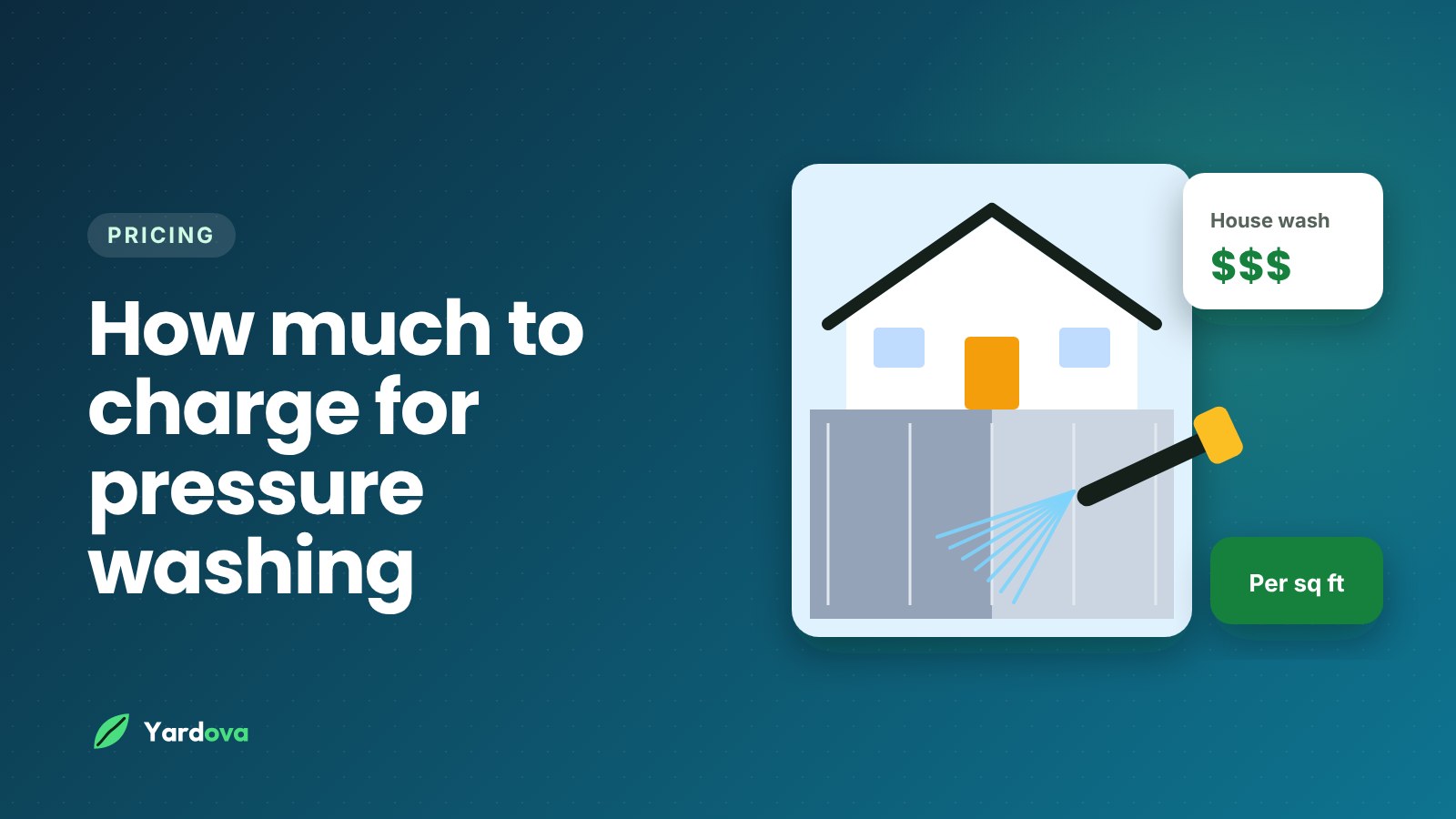
Knowing how much to charge for pressure washing is what separates a busy washing business from a profitable one. You can stay booked every weekend and still end the season with little to show for it if your prices don't cover chemicals, fuel, equipment wear and your own time. Price too high without a reason and the leads dry up. The fix is a simple, repeatable way to price every job.
This guide covers the common pricing methods, how to work out your own hourly target, how to price house washes, concrete, decks, roofs, gutters and commercial work, plus add-ons, repeat plans, minimums, remote quotes, pushback and price increases. Every dollar figure below is an example to show the math, not an industry statistic. Plug in your own costs and check your own market.
Why your pressure washing prices have to start with your costs
Most new washing businesses set prices by looking at a few competitors' websites or asking in an online group. That shows roughly what customers in your area are used to seeing. It does not tell you whether that price works for your rig, your drive times and your overhead.
Two operators can charge the same price for the same driveway. One makes good money because his trailer setup is paid off, his surface cleaner is fast and his jobs are close together. The other loses money because he is still paying off a skid unit, drives an hour each way and cleans with a wand. Same price, very different results.
So build your price from your costs first, then compare it with the market. If your cost-based price lands well above what your area pays, look at your equipment, efficiency or service area, not only at cutting the price.
Pressure washing vs. soft washing pricing
Pressure washing uses high pressure on hard surfaces like concrete. Soft washing uses low pressure and cleaning solutions on siding, roofs and other surfaces that high pressure can damage. The pricing method is the same, but soft washing usually carries higher chemical costs, more setup and more risk to plants and property, and your price should reflect that. Chemical handling and runoff rules vary by state, county and city, so check what applies where you work.
Step one for how much to charge for pressure washing: your cost per hour
Before you quote a single house, you need to know what one hour of your rig in the field costs you. Everything else builds on that number.
Add up your yearly overhead
Overhead is what you pay whether you wash one house or fifty. For example:
- Truck payment, insurance and maintenance
- Trailer, pressure washer, surface cleaner, pumps, hoses and tank, or a yearly amount set aside to replace them
- Business insurance and any licenses your area requires
- Phone, software, website and marketing
- Bank fees, bookkeeping help and storage space
Suppose your example overhead adds up to $20,000 a year. If you work about 1,000 billable hours in a season (time spent on paid jobs, not driving to estimates or fixing an unloader), your overhead is $20 per billable hour.
Add your direct costs per hour
Direct costs rise and fall with the work:
- Chemicals and surfactants
- Fuel for the truck and the machine
- Wear parts: tips, O-rings, hoses, wands, pump packing
- Labor for helpers, including payroll taxes and workers' comp
For example, chemicals, fuel and parts might average $12 an hour. If you work alone, pay yourself a real wage here, such as $30 an hour. Your time is not free just because you own the business.
Add the profit you want
Profit is separate from your wage. It is what the business keeps for replacing a pump, surviving a rainy month and buying a second rig. Many owners aim for around 15 to 25 percent on top of costs.
Here is the example math for a solo operator:
- Overhead: $20 per hour
- Chemicals, fuel and parts: $12 per hour
- Owner wage: $30 per hour
- Total cost: $62 per hour
- Add 20 percent profit: about $74 per hour
That $74 is your example target billable rate. Whenever you ask yourself how much to charge for pressure washing a given job, check the answer against your own version of this number.
The four common pressure washing pricing methods
Once you know your hourly target, you need a way to turn it into a price. There are four common methods, and most experienced operators blend them.
Pressure washing price per square foot
Pricing by square foot is popular for driveways, patios, pool decks and parking areas. You measure the area, often on an online map before you ever visit, and multiply by your rate.
To set a rate, time yourself. For example, if your surface cleaner covers about 600 square feet of moderately dirty concrete in an hour, including pre-treat and rinse, and your target is $74 an hour, your rate is about 12 cents a square foot. Heavy staining, oil or rust raises the time and the rate. Commonly quoted ranges vary widely by region, so your own timed results matter more than any number you see online.
Price per job
Many customers just want one number: "What does it cost to wash my house?" A flat per-job price is easy to understand and approve. You build it behind the scenes from time and materials, then present a single total. It works well for house washes, where you can set tiers by size and stories, and for packages.
Hourly pricing
Charging by the hour is less common for residential work because customers worry about how long you'll take. It can fit jobs that are hard to predict, like graffiti removal, equipment cleaning or a commercial client who books a set block of time. Even when you don't charge hourly, calculate hourly. That is how you know your other prices work.
Minimum charge
A minimum charge is the least you will accept to show up. A small walkway still requires loading, driving, setup and cleanup. We cover how to set it below.
How much to charge for pressure washing by job type
Each type of job has its own time drivers and risks. Here is how to price the common ones, with example math using the $74-per-hour target. These are not market prices; they show how to apply the method.
House washing prices
House washes are usually soft washes priced per job, with tiers by size and stories. Factors that change the price:
- Square footage of siding and number of stories
- Siding type (vinyl, painted wood, stucco, brick)
- Heavy mildew or algae that needs extra dwell time or a second pass
- Landscaping that needs pre-wetting or covering
- Access: fences, slopes, tight side yards, ladder work
For example, a two-story house that takes about 2.5 hours including setup, pre-wetting plants, application, rinse and cleanup comes to about $185 in time, plus $25 in chemicals. A price around $210 hits your target.
Driveway cleaning cost and other concrete
Driveways, sidewalks, patios and pool decks are usually priced per square foot or as a flat price per surface. The price goes up for oil, rust, tire marks and heavy organic growth, and for areas broken into many small sections. Post-treatment to slow regrowth and sealing are separate line items.
For example, a 900-square-foot driveway with normal dirt and some growth at about 12 cents a square foot comes to about $108.
Decks and fences
Wood needs lower pressure and more care, since too much pressure can raise the grain or etch the boards. Price by square foot, linear foot or per job, and add time for railings, spindles and stairs, which take far longer than flat boards. Brightening, stripping and staining are separate add-ons.
For example, a 300-square-foot deck with railings and stairs that takes 1.5 hours plus $15 in products comes to about $126.
Roof cleaning pricing
Roofs are typically soft washed, and they are among the higher-risk jobs you can take. Price for the risk, not just the time:
- Pitch and height, and whether you need to walk the roof
- Roofing material and any manufacturer cleaning guidance
- Amount of growth and protection for plants and gutters below
- Your insurance coverage for roof work, which you should confirm with your insurance agent
Many owners set a higher minimum for roofs and decline steep or high roofs they are not set up for. Passing on a job is fine.
Gutter cleaning and brightening
Gutter work comes in two kinds: cleaning out debris and brightening the outside face to remove black streaks. Price them separately, per linear foot or per story, and spell out which one the customer is getting. The easiest time to sell either one is as an add-on to a house wash.
Commercial and storefront pricing
Commercial work includes storefronts, sidewalks, drive-thrus, dumpster pads and building exteriors. It often means night or early morning work, water recovery or runoff rules depending on your area, proof of insurance, and repeat schedules.
For example, a storefront sidewalk that takes 45 minutes at $74 an hour is about $56 per visit. Many owners price recurring commercial work as a monthly amount and add a little for off-hours.
Add-ons, upsells, bundles and repeat-service plans
The first job gets you in the door. When you think about how much to charge for pressure washing over a whole year, add-ons and repeat plans are often where the better margins are, because you are already set up on the property.
Add-ons that fit pressure washing
- Gutter brightening or cleanout
- Window rinsing after a house wash
- Concrete sealing or post-treatment
- Deck or fence staining
- Rust or oil stain treatment
- Patio furniture or trash can cleaning
Price each add-on the same way: time plus materials plus profit. For sealer or stain, mark up what you pay. You are covering the supply run, handling and the risk of overbuying.
Bundles
Bundles make the decision easy and raise your average ticket. "House wash, driveway and front walk" as one package price is simpler than three line items. Build it from the separate prices and round down slightly so it feels like a better deal.
Repeat-service plans
Many washing customers are one-and-done. A repeat plan changes that:
- A yearly house wash scheduled each spring
- Twice-a-year concrete cleaning for shady properties
- Monthly or quarterly commercial sidewalk and dumpster pad cleaning
Offer a small incentive for signing up, such as a few percent off or a free add-on each visit. You get predictable work and lower marketing costs. Pair repeat plans with saved cards and automatic payments; our guide on how to get paid faster as a service business covers the details. If you also do lawn or landscape work, the same rules apply there; see how to write a landscaping invoice.
Travel fees and your pressure washing minimum charge
Drive time is the cost most new owners leave out when they work out how much to charge for pressure washing. Forty minutes each way to a small patio job can wipe out the profit.
How to set a minimum charge
Add up the time every job takes before you pull the trigger. For example:
- Drive to the job: 20 minutes
- Unload, run hoses and set up: 15 minutes
- Clean up, roll hoses and load: 15 minutes
That is about 50 minutes of fixed time. Add a short job of 30 minutes and you have about 80 minutes. At $74 an hour, that suggests an example minimum of around $100.
A minimum protects you from jobs that look quick on paper but eat half a morning. Raising a too-low minimum is one of the fastest ways to raise your average hourly earnings.
Travel fees and service areas
Set a home service area and charge a travel fee outside it, such as a flat amount for each 10 miles beyond your normal area, or a higher minimum for distant jobs. You can also batch far-away jobs on the same day. Our post on crew scheduling for service businesses covers grouping jobs by area.
How to quote pressure washing jobs from photos and the phone
Driving out to quote every job costs time you could spend washing. Many businesses quote most residential jobs remotely, using maps, customer photos and a few good questions. Remote quoting is where knowing how much to charge for pressure washing turns into speed: with your rates set, you can answer in minutes.
Questions to ask on the phone or by text
- What surfaces do you want cleaned?
- How many stories is the house, and what is the siding?
- Is there oil, rust or heavy staining?
- Is there a working outdoor spigot?
- Are there gates, pets or tight access points?
- Is there a deadline, like a sale, a party or an HOA notice?
What to look for in customer photos
Ask for a photo of each side of the house and each surface. Look for thick mildew on shaded walls, oxidized siding that may chalk or streak, delicate plants close to the house, loose siding or peeling paint you should note before you start, and rust or oil on concrete. If something looks unusual, say in writing that the price is based on the photos and could change after an on-site check.
Step-by-step: how to quote a pressure washing job
- Collect the address, the surfaces and photos.
- Measure flat areas on an online map and note house size and stories.
- Estimate on-site time for each surface, including setup and cleanup.
- Add chemicals and products for each surface.
- Add drive time or a travel fee if the job is outside your area.
- Multiply time by your hourly target and add materials.
- Sanity-check against your per-square-foot rates and tiers.
- Apply your minimum charge.
- Offer one add-on or bundle that fits what you saw.
- Write down what is included, what is not, and what could change the price.
- Send the quote the same day with a simple way to approve it.
The company that sends a clear price first often gets the job. For more on wording and layout, see how to write a quote for a service business.
Sample pressure washing quote message
Here is a template you can adapt for text or email:
Hi Jason, thanks for sending the photos. Here's your quote for 123 Oak St: soft wash of the two-story house (all four sides), $210. Driveway and front walk surface cleaning, $125. Together as a package: $315. This includes pre-wetting and rinsing your plants and a final rinse of the windows. Rust stains near the garage are not included but can be treated for $40. Pricing is based on your photos; if anything looks different on site, I'll check with you before starting. You can approve here and pick a day that works. Thanks!
Handling "that's too expensive" and raising pressure washing prices
Every washing business hears price pushback. How you handle it decides how much you keep.
What to say when a customer says it's too expensive
Don't drop your price on the spot. Instead:
- Ask what they are comparing it to. The other quote may be driveway only, or high pressure on siding.
- Explain what is included: plant protection, soft wash on siding, cleanup, insurance.
- Offer a smaller scope instead of a lower rate: "We could do the driveway now and the house next month."
- Offer a repeat-plan incentive if they commit to regular service.
- Let them go politely if the gap is large.
When and how to raise prices
Chemicals, fuel, insurance and equipment cost more every year. If your prices stay flat, your pay goes down. Revisit how much to charge for pressure washing at least once a year, ideally before your busy season, and especially when your calendar is full weeks out or repeat customers are well below your new-customer prices.
A modest yearly increase is easier to accept than a big jump every few years. Give repeat customers a few weeks' notice with a short note, such as: "Starting March 1, your yearly house wash will be $225. That covers higher chemical and fuel costs so we can keep the same quality and care."
Most good customers accept a fair, clearly explained increase. Reliable service and good reviews give you room to keep prices healthy; see how to get more Google reviews for a simple system.
Pressure washing pricing checklist
Use this checklist every time you decide how much to charge for pressure washing a property:
- Know your current hourly target, including overhead, your wage and profit
- Confirm each surface and whether it gets pressure or soft washing
- Measure flat areas and note house size and stories
- Check photos for mildew, oxidation, stains and delicate plants
- Ask about water access, gates, pets and parking
- Estimate on-site time per surface, including setup and cleanup
- Add chemicals and products with a markup
- Add a travel fee for jobs outside your area
- Apply your minimum charge, with a higher minimum for roofs if you use one
- Offer an add-on, bundle or repeat plan
- List what is included and what could change the price
- Send the quote the same day and follow up if there is no answer
Common pressure washing pricing mistakes
- Not counting your own time. If your price only covers fuel and chemicals, your "profit" is really your wage.
- Ignoring drive and setup time. It adds up to hours every week.
- Pricing soft washing like pressure washing. Higher chemical costs and risk deserve a higher price.
- Under-pricing roofs. The risk and the insurance cost are real.
- Dropping your price at the first pushback. Adjust the scope, not the rate.
Tools that help you decide how much to charge for pressure washing
A notebook and calculator work at first, but a few tools save real time once leads pick up:
- A saved price list so every quote uses the same rates
- A quote request page where customers send their address, details and photos
- Quotes customers approve from their phone, with an optional deposit for bigger jobs
- Repeating jobs, saved cards and autopay for yearly and monthly plans
- Missed-call text back so a caller still gets a reply while your surface cleaner is running
That last one matters more than it sounds; see how missed calls cost service businesses jobs. Yardova's pressure washing software puts these pieces in one place, from the quote request page to quotes built from your price list, one-tap approval and invoices customers pay by card, Apple Pay or Google Pay.
Frequently asked questions
How much should I charge to pressure wash a house?
Charge your hourly target times the hours the house takes, plus chemicals, with your minimum charge as the floor. Count setup, pre-wetting plants, application, rinse and cleanup, not just spraying. Most operators present one per-job price based on size and stories, and prices vary widely by region.
Is it better to charge by the square foot or by the job?
Square-foot pricing works best for flat concrete, while per-job pricing works best for house washes and packages. Many operators use square-foot rates behind the scenes and show one total. Either way, check the result against your hourly target.
How do I figure out my pressure washing price per square foot?
Time how many square feet you clean in an hour, then divide your hourly target by that number. For example, a $74 target and 600 square feet an hour gives about 12 cents a square foot. Raise it for heavy staining that slows you down.
What is a good minimum charge for pressure washing?
A good minimum covers your fixed time for every job plus the shortest realistic wash, at your hourly rate. Add drive time, setup and cleanup, then a short job, and multiply by your target. Many owners set a higher minimum for roofs.
Should soft washing cost more than pressure washing?
Soft washing usually costs more per hour of work because chemical costs, setup and risk are higher. You are protecting plants, siding and roofs, and a mistake can be expensive. Price for those extra costs instead of using your concrete rate.
Can I quote pressure washing jobs without seeing the property?
Yes, many washing businesses quote most residential jobs from photos, online maps and a few questions. Ask for photos of each side and each surface. Note in writing that the price could change if conditions on site are different.
Wrap-up: how much to charge for pressure washing, step by step
Working out how much to charge for pressure washing comes down to a process you can repeat on every job:
- Know your real cost per hour, including overhead, chemicals, your wage and profit
- Pick the right method for each surface: square foot, per job, hourly or minimum
- Price soft washing, roofs and commercial work for their extra cost and risk
- Set a minimum charge and a travel fee for far-away jobs
- Sell add-ons, bundles and repeat plans
- Quote from photos and maps, and send the quote the same day
- Hold your rate on pushback, and raise prices a little every year
Do this consistently and your weekends on the rig turn into a business that pays you properly. When you want quoting, scheduling and payments in one place, start a free Yardova account, compare plans and pricing, or book a demo and we'll walk through it with you.