What's the Best App to Price Tree Work? A Quoting Guide
Looking for an app to price tree work? Learn how to price removals, trimming and stump grinding, build a price list, and quote tree jobs on site.
The Yardova team · October 30, 2026 · 16 min read
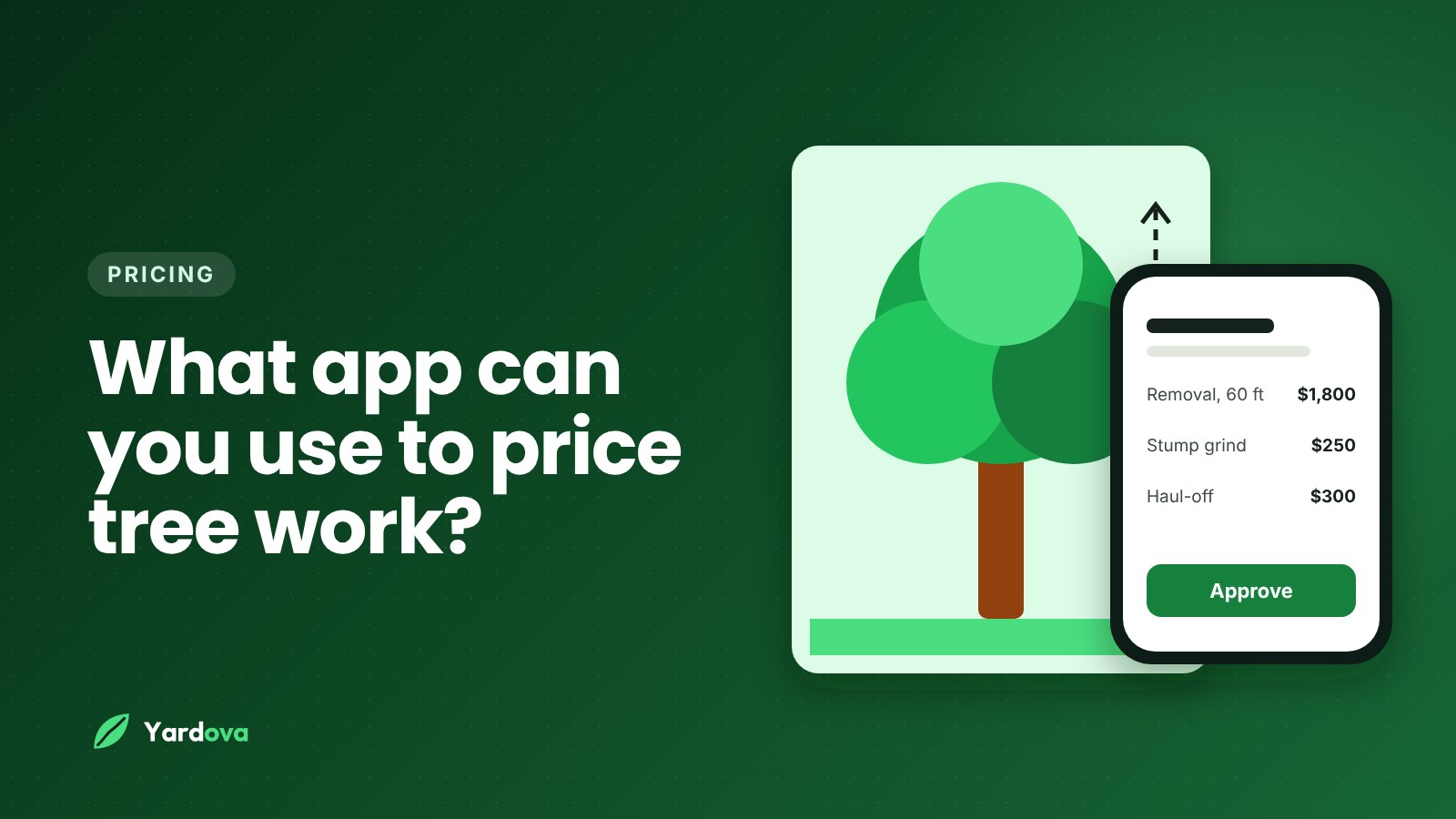
If you are searching for an app to price tree work, you already know the problem: you walk a property, look up at a leaning oak over the garage, and have to turn that into a number the customer will accept and your crew can live with. A notepad and a guess work for a while. Once you are bidding several jobs a day, guesses start costing you money.
No app knows how to price a tree. You do. What a good app does is hold your prices, your formula and your photos in one place so every quote is consistent, fast and easy to say yes to. This guide covers both halves: how tree work is actually priced, and what to look for in the tool you use.
Every dollar figure below is a simple example to show the math. Plug in your own costs and your own market.
What an app to price tree work actually needs to do
Before comparing features, get clear on the job you need the app to do. For most tree service owners, it comes down to five things:
- Hold your pricing. Rates for removals, trimming, stump grinding and haul-off live in one saved list, not in your head.
- Work on your phone in the yard. You quote standing next to the tree. If it needs a laptop, it will not get used.
- Capture the job. Photos, measurements and notes attach to the quote so the crew sees exactly what was promised.
- Get a fast yes. The customer reads and approves the quote from their phone, with no printing or scanning.
- Carry the job through. An approved quote becomes a scheduled job and later an invoice without retyping.
A spreadsheet handles the first item and a notes app the third. A real app to price tree work connects all five.
How tree work is priced: the factors that move the number
Tree service pricing is harder than most trades because no two trees are the same. A 60-foot pine in an open backyard and a 40-foot maple hanging over a roof can take wildly different amounts of time and risk. Before you load anything into an app to price tree work, know what moves the number.
Tree height and trunk diameter
Height and diameter are the starting point. Taller trees mean more climbing or rigging, more cuts and more wood on the ground. Diameter, usually measured at about chest height, tells you how heavy each piece will be.
Many companies group trees into size bands, for example small (under about 30 feet), medium (about 30 to 60 feet) and large (over about 60 feet). Bands keep quoting fast, but the next factors decide where in the band a job really lands.
Location and hazards near structures or power lines
A tree that can be felled in one piece into an open yard is a very different job from one that has to be pieced down and lowered over a house, fence, pool or septic system.
Power lines change the job completely. Work near energized lines is tightly regulated, and in many cases only qualified line-clearance workers may do it. Keep it simple: if a tree is near lines, note it, check the current rules in your area, and contact the utility when needed before you commit to a price or a date.
Other hazards to note and price for:
- Dead, hollow or decayed wood that cannot be trusted for climbing or rigging
- Trees leaning toward a structure
- Multiple trunks or weak unions that could split
- Storm damage with hung-up limbs or wood under tension
- Cars, play sets or landscaping the customer cares about
Access for equipment and the crew
Access decides what equipment you can use and how far you carry wood. On every walk-through, ask:
- Can a bucket truck, chipper or loader get close to the tree?
- Is there a narrow gate, slope, soft ground or septic field in the way?
- Will you need ground protection mats to avoid rutting the lawn?
- How far is it from the tree to the chipper?
A backyard tree with no equipment access takes far longer, because every piece is carried out.
Equipment: climbing, bucket truck or crane
Each method has a different cost per hour. Climbing needs the fewest machines but the most skill and often the most time. A bucket truck is faster when it can reach. A crane can make a dangerous removal faster and safer, but it brings rental or operating cost, setup time and usually a minimum.
Price the equipment the job needs, not the equipment you happen to own. A crane job quoted as a climb means extra risk and unpaid hours.
Crew hours
Most of the cost of tree work is labor. Estimate how many people the job needs and for how long, including setup, cutting, rigging, chipping, cleanup and loading. A three-person crew for six hours is 18 labor hours, not 6.
Debris haul-off and dump fees
Chipping on site is fast, but you still have chips to dump or deliver. Logs may be left in rounds, split and stacked, or hauled away. Dump or green waste fees, the drive to the yard and the time to unload all belong in the quote. If you run haul-off as its own service, our guide on junk removal business software covers how hauling businesses organize loads and pricing.
Stump grinding
Stump grinding is usually priced separately so the customer can choose. Many companies charge by stump diameter at ground level, with a minimum per visit. Surface roots, grind depth, rocks and grinder access all change the time.
Permits and local rules
Some cities, counties and homeowners associations require a permit to remove certain trees, especially large or protected ones or trees in a public right of way. Rules vary a lot. Note whether a permit may be needed, check the local rules, and state in the quote who is responsible for getting it.
Know your cost per crew hour first
Every price list and every app to price tree work is only as good as the numbers you feed it. The most important number is what one hour of your crew in the field costs you.
Overhead is what you pay whether you work or not: truck, chipper and grinder payments, insurance including general liability and workers' comp, training, phone, software, marketing, and yard rent. Direct costs rise with each job: fuel, chains, bar oil, rigging wear, chipper knives, dump fees and labor with payroll taxes.
Here is a simple example for a three-person crew:
- Overhead spread across billable hours: $40 per crew hour
- Fuel, wear parts and supplies: $20 per crew hour
- Labor for two employees including payroll costs: $60 per crew hour
- Owner wage as the climber: $40 per crew hour
- Total cost: $160 per crew hour
- Add 25 percent profit: $200 per crew hour
In this example, $200 is the target. If your formula says a removal is $900 but it will take the crew six hours, you are well under target and should rethink the price.
How to price tree removal, trimming and stump grinding with a price list
Once you know your crew-hour target, build a price list you can load into an app to price tree work so the same tree gets the same price no matter who quotes it.
Tree removal: base price plus adjustments
A common approach is a base price by size band, plus adjustments:
- Base price by size band (small, medium, large)
- Add for hazards: over a structure, dead wood, storm damage
- Add for access: no equipment access, long carry, mats needed
- Add for equipment: bucket truck or crane
- Add for haul-off: logs removed instead of left on site
- Stump grinding as a separate line item
Write down roughly how much time each adjustment adds. That keeps the list grounded in crew hours, not round numbers that felt right.
Tree trimming estimate
Trimming is harder to price per tree because the scope varies. A light crown cleaning, deadwood removal, roof clearance and heavy reduction are very different jobs. Many companies price trimming by estimated crew hours with a clear scope. "Remove deadwood over 2 inches and clear branches 6 feet off the roof" beats "trim tree" every time.
Stump grinding price per inch
Per-inch pricing is easy for customers to understand. Measure the widest point at ground level, multiply by your rate, and apply a minimum for the visit. Add for large surface roots, extra depth or hauling the grindings.
Cleanup and haul-off
Decide what cleanup is standard and what costs extra. Standard might be "chip all brush, rake and blow the work area." Extra might be "haul away all logs" or "split and stack firewood." Make each one a line item.
Tree removal pricing examples
These use the example $200 crew-hour target. They are not market prices. They show how to turn a walk-through into a number.
Example 1: medium tree, open backyard, good access
- Three-person crew, about 3 hours including chipping and cleanup
- Bucket truck can reach; logs left for the customer
- 3 hours at $200 is $600
- Dump fee and drive for chips: about $60
- Example price: about $660, stump grinding quoted separately
Example 2: large tree over a house
- Climber plus two ground crew, rigging every piece down
- About 7 hours with extra setup and slower cuts: $1,400
- Hazard adjustment for working over the roof: about $250
- Logs hauled away, two dump runs: about $200
- Example price: about $1,850
Quote this like Example 1 with a small bump and you lose most of a day's pay.
Example 3: stump grinding
- Two stumps, 18 and 24 inches across
- Example rate of $4 per inch: 42 inches is $168
- Example minimum visit charge of $150 does not apply
- Hauling grindings: about $40
- Example price: about $208
Save jobs like these as templates in your tree service estimate app, and the next similar job takes a minute to quote instead of twenty.
What to look for in an app to price tree work
Rather than chase brand names, judge any tool against how a tree crew actually works.
A saved price list you control
Load your removal bands, adjustments, trimming rates, stump grinding per inch and haul-off fees, then pick from them while you quote. Line items should be editable on the fly, because every tree has something unusual.
Photos attached to the quote
A photo with the tree, the house and the lines in frame shows why the price is what it is. Later, the same photos tell the crew exactly which tree comes down and which one stays.
Quotes sent from your phone on site
The best time to send a tree quote is before you leave the driveway. Look for a tool that builds a clean quote on a phone and sends it by text or email in a minute or two.
Online approval and deposits
The customer should approve the quote with a tap. For large removals or crane jobs, an optional deposit at approval protects your schedule and covers equipment you need to book. A deposit of around 25 percent is common on bigger jobs, while small trims often skip it.
Scheduling and invoicing in the same place
Tree jobs often need several people, specific equipment and the right weather. Look for scheduling that puts multiple crew members on one job and makes rain or wind delays easy to move. Our post on crew scheduling for service businesses goes deeper.
When the job is done, the approved quote should become an invoice without retyping, with card payments and automatic reminders. See how to get paid faster as a service business for more.
Using photos and measurements to quote tree jobs accurately
Good inputs make good quotes, whether you price on paper or with an app to price tree work.
Measuring height and diameter
Be consistent more than exact. Common field methods for height:
- A laser rangefinder or clinometer
- The stick method: hold a stick as long as your arm at arm's length, and back up until it covers the tree from base to top; your distance is roughly the tree's height
- Comparing to a known height, such as a two-story roofline
For diameter, use a diameter tape, or measure around the trunk and divide by about 3.14. Record it on every tree you quote. Over time those notes become your own pricing history.
Photos that tell the whole story
Take a few photos of every tree:
- The whole tree with nearby structures in the shot
- The base and trunk, showing decay or multiple trunks
- The access path from the street or driveway
- Lines, fences, pools or landscaping at risk
- The stump area if grinding is included
Customer photos before you visit
Photos from the customer let you plan equipment and sometimes give a price range by text. For anything near a house or lines, still walk it in person.
The best way to quote tree work on site, step by step
Here is a process you can repeat on every walk-through. It is much faster with an app to price tree work on your phone.
- Confirm the scope. Point at each tree with the customer: removed, trimmed or left alone.
- Walk the access path. Check gates, slopes, soft ground and how close equipment can get.
- Measure each tree. Note height, diameter, species and condition.
- Look up and around. Note structures, lines and hazards that change your method.
- Choose the method and crew. Climbing, bucket truck or crane, and how many people.
- Estimate crew hours. Include setup, cutting, chipping, cleanup and travel.
- Decide on debris. Chip on site, haul logs, leave wood, or split and stack.
- Price stumps separately. Measure each one and apply your per-inch rate and minimum.
- Flag permits. Note whether one may be needed and who handles it.
- Take photos and attach them to the quote.
- Build the quote from your price list with adjustments for hazards, access and equipment.
- Check against your crew-hour target and adjust if the total falls short.
- Send it before you leave and tell the customer it is on their phone.
For wording and layout, see our guide on how to write a quote for a service business.
Tree job pricing checklist
Run through this on every tree quote:
- Which trees are included, and which are not
- Height, diameter, species and condition of each tree
- Distance to house, garage, fence, pool and other structures
- Power lines nearby, and whether the utility or line-clearance workers are needed
- Access for bucket truck, chipper, grinder and crew
- Ground protection for lawns or soft ground
- Method, crew size and estimated hours
- Equipment rental or crane costs, including minimums
- Brush and logs: chipped, hauled, left, or split and stacked
- Dump fees and drive time to the dump
- Stump grinding: count, diameter, grindings removed or not
- Permits, HOA approval and who is responsible
- Deposit amount, if any
- Price checked against your crew-hour target
- Photos attached
Saved as a template in your app to price tree work, this checklist keeps newer estimators on the same steps you follow.
How to avoid underpricing tree jobs
Tree work carries more risk and cost than most trades, so underpricing hurts. Common mistakes:
- Pricing the tree, not the job. The same tree can be two hours or a full day depending on what is under it.
- Forgetting cleanup and haul-off. Chips, logs and dump fees eat margin fast.
- No minimum charge. Small trims and single stumps still need a truck, a crew and travel.
- Quoting the cheap method. If the job needs a crane or bucket truck, quote it that way.
- Not charging for hazard. Dead wood, storm damage and work over roofs take more time and care.
- Ignoring drive time. A job an hour away costs two hours of crew time before a single cut.
- Leaving scope vague. "Trim trees" invites arguments. Spell out what will and will not be done.
Insurance and safety belong in your price
Tree work is dangerous, and insuring it is not cheap. General liability, workers' comp, training, protective gear and good rigging equipment are real costs that belong in your overhead. A line on your quote such as "fully insured, certificate available on request" helps customers see why an insured, trained crew costs more than someone with a chainsaw and a pickup. Check your own policy and local requirements so everything you claim is accurate.
Tree service quote follow-up and closing the job
Many tree quotes are not lost to a cheaper bid. They are simply forgotten. A short follow-up a few days later brings a lot of them back. Here is a text you can adapt:
Hi Dan, this is Mike with Ridgeline Tree Care. Just checking in on the quote we sent Tuesday for removing the oak over your garage and grinding the stump. You can approve it right from the link in that text, and we can usually get you on the schedule within a couple of weeks. If you have any questions about the price or the plan, just reply here and I'll give you a call.
Name the job and make the next step obvious. If you miss calls while you are up in a tree, those leads go cold even faster; see how missed calls cost service businesses jobs.
This is where an app to price tree work earns its keep. Yardova's tree service software lets you build quotes from your saved price list, or describe the job in plain words and have AI draft the quote for you to review. You send it by text or email, and the customer approves it online in one tap, with an optional deposit. The job then goes on the schedule with your crew, where they can add before and after photos, becomes an invoice the customer can pay by card when it is done, and daily AI follow-up drafts flag quotes that have not been answered.
Frequently asked questions
What app can you use to price tree work?
You can use any quoting or field service app that saves your own price list, attaches photos and sends quotes from your phone. The app does not set your prices, so load it with your own rates for removals, trimming, stump grinding and haul-off. Look for online approval, deposits, scheduling and invoicing in one place.
How do you price a tree removal?
Estimate crew hours and equipment, then add hazard, access, haul-off and dump costs. Start with height and diameter, adjust for structures, lines and access, and use the method you will actually use. Check the total against your target rate per crew hour.
How much should I charge per inch for stump grinding?
Set a per-inch rate from your grinder's operating cost and your time, plus a minimum charge per visit. Measure the widest point at ground level and add for big surface roots or hauling grindings. Rates vary a lot by region, so compare your result with local companies.
Should tree service companies require a deposit?
Many tree companies ask for a deposit on large removals, crane jobs or jobs that need rented equipment. Around 25 percent is common on bigger jobs, while small trims often have none. Collecting it when the customer approves the quote keeps it simple.
Can you quote tree work from photos?
Yes for simple trims and small removals, but anything near a structure or power lines should be seen in person. Photos help you plan equipment and give a quick price range. For risky jobs, a walk-through protects you and the customer.
Do I need a permit to remove a tree?
It depends on where the tree is and local rules. Some cities, counties and homeowners associations require permits for large or protected trees or trees near a public right of way. Check the current local rules and say in your quote who is responsible for the permit.
What should a tree service quote include?
List each tree, the work to be done, the method, cleanup and haul-off, stump grinding and the price. Add photos, permit notes, deposit terms and what is not included. The clearer the scope, the fewer arguments on the day of the job.
Wrap-up: choosing an app to price tree work and pricing it right
The right app to price tree work does not replace your judgment. It holds your numbers and makes them fast to use. To price tree jobs well:
- Know your cost per crew hour and add real profit
- Build a price list with size bands and adjustments for hazards, access, equipment and haul-off
- Price stump grinding per inch with a minimum
- Measure, photograph and note every tree you quote
- Follow the same on-site process and checklist every time
- Send the quote before you leave and follow up a few days later
- Keep insurance, safety and dump fees inside the price
To see this on your own jobs, start a free Yardova account, compare plans and pricing, or book a demo and we will walk through a tree quote with you.